Hammond School of Grease: Confessions From the Man Behind the Spin
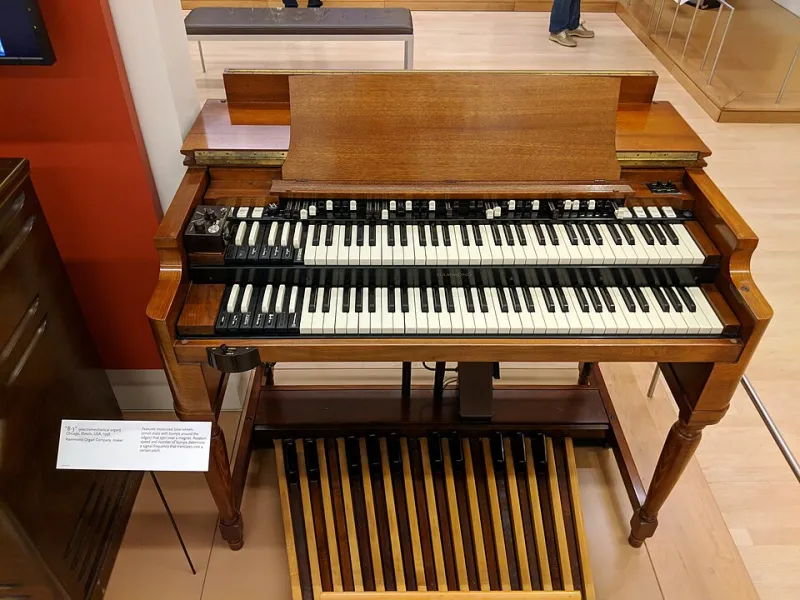
Photo: bobistraveling, CC BY 2.0, via Wikimedia Commons
There's a moment in every great funk show — usually about two songs deep — when the keyboard player leans back, flips a switch, and suddenly the whole room sounds like it's breathing through a spinning fan in a barbecue joint. That's not an effect. That's not a plugin. That's a Hammond organ, baby, and if your band doesn't have one, your band has a hole in it.
We sat down with our own keys man between load-in and soundcheck, while he was elbow-deep in the back of a Leslie cabinet that's older than most of our fanbase, and asked him to explain the cult.
The Machine That Purrs
"People think it's a keyboard," he told us, wiping tone-arm grease off his knuckles. "It's not a keyboard. It's a lawnmower engine with a church attached."
He's not wrong. The Hammond B-3, born in 1935 as affordable church furniture, works by spinning tonewheels past pickups — no oscillators, no samples, just metal teeth singing at different pitches. Run that through a Leslie speaker, which physically spins its horn at variable speeds, and you get that warble, that wobble, that thing that sounds like gravy being poured directly into your ear canal.
"Fast Leslie on a chord," he said, demonstrating. The room filled with a sound like a carousel falling down a staircase in the best possible way. "That's the headache. That's what people pay for."
Why Funk Married the Organ
Booker T. Jones proved it first — "Green Onions" is basically a B-3 doing the strut while the rest of the band holds its hat. Then Jimmy Smith dragged the instrument out of the sanctuary and into the club, playing bass lines with his feet and his left hand while his right hand sang. By the time the '70s rolled around, every funk band worth its sweat had a keyboard rig that weighed more than the drummer.
The organ does things a guitar can't. It sustains forever. It swells like a wave. Chord stabs on a B-3 with the percussion on and the drawbars pulled fat — that's the glue between the bass and the horn section. It's the reason a four-piece can sound like nine people and a congregation.
"My job in the band," our guy says, "is to be the weather. The horns are lightning, the bass is thunder. I'm just the humidity. Nobody notices humidity until it's gone."
The Bar-Band Buyer's Guide
So you want the grease. Here's the honest math, from a man who's bought, sold, and rescued more organs than he'll admit to his spouse.
The dream: A vintage B-3 with a Leslie 122. Prices have climbed — decent packages run $6,000 to $12,000 these days, and shipping a 400-pound monster up your staircase is a separate invoice from God. Check the tonewheels for chewed-up teeth, listen for a whining start motor, and always, always play every key before you hand over cash.
The workable: An A-100 or a C-3. Same guts as the B-3, different furniture, often half the price because collectors are snobs about wooden side panels. A-100s turn up on Facebook Marketplace from retired churches constantly. Bring a truck and a friend with a strong back and a weak sense of self-preservation.
The realistic: A Nord C2D or a vintage-styled clonewheel through a Motion Sound rotary cab. Does it weigh 40 pounds instead of 400? Yes. Will the purists squint? Sure. Will the dance floor know the difference at 1 a.m.? Absolutely not. The Leslie simulation has gotten scary good, and your back will thank you around year three.
The sleeper pick: A busted-up M-3, the "chop it and strap a Leslie to it" special. Half the band's heroes learned on chopped Ms. It's the punk rock entry point — ugly, heavy, and mean as a hornet.
Keep It Spinning
Maintenance is a religion. Oil the motor every few months with the proper Hammond oil or it'll sound like a dying cat choir. Learn to clean bus bars — that famous scratchy key contact is fixable with a jiggle and a prayer. And never, ever let the soundman tell you the Leslie "doesn't need a mic on it." It needs two, and it needs them pointed at a man who knows what he's doing.
The organ isn't the loudest voice in funk. It's the thickest. It's the swirl under the stab, the grease under the gravy, the reason your chest hums on the drive home. Every funk band needs a headache. Get you one.