When the Breaker Takes a Solo: Surviving Dead Air Without Losing the Groove
The Sound Dies, the Room Doesn’t
It usually happens on the one. The bassist is locked in, the horn line is stacked tight, the drummer is riding that greasy little hi-hat pattern that makes the whole room lean forward — and then the PA makes a sound like a refrigerator unplugging. The lights stay on. The crowd stays put. The groove does not.
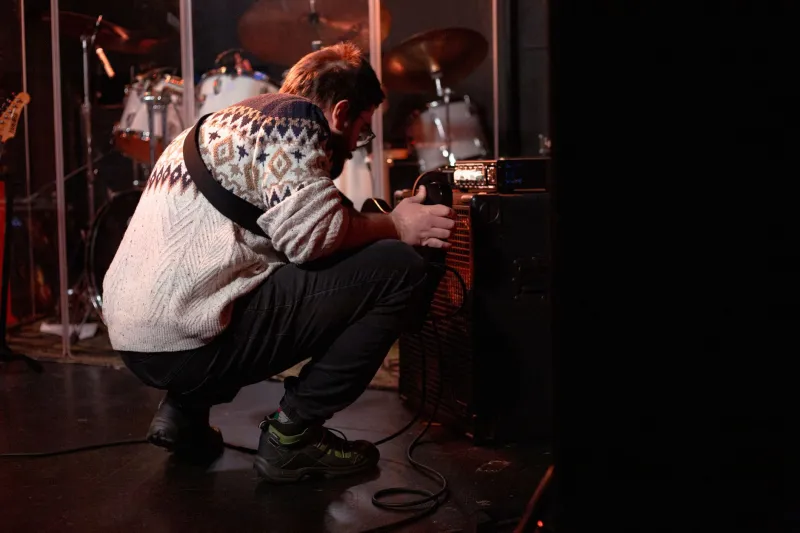
Every funk band that has played more than a dozen rooms knows this moment. A breaker blows because the club’s ancient wiring is held together by tape and prayer. An amp overheats in a backline that has seen too many state fairs. A cable gets kicked loose by a dancer who treated the stage edge like a personal runway. The cause changes; the silence feels the same. It is long, loud, and full of people waiting to see whether the band is about to fold.
The worst instinct is to freeze. The second-worst is to start apologizing into a dead microphone. The best funk bands treat a gear failure like a breakdown in the tune: somebody has to hold the pocket until the rest of the machine comes back online.
First Five Seconds: Do Not Explain, Do Not Panic
When the sound drops, the band’s job is to keep the room from thinking the show is over. That means no huddle at the amp. No confused staring at the board. No lead singer yelling “hold on, folks” into a mic that is not working anyway.
Instead, the drummer becomes the anchor. A simple, steady kick-and-snare pattern — nothing fancy, nothing fast — tells the crowd that the rhythm is still alive. If the drummer has a cowbell within reach, even better. A cowbell is a beautiful thing in a crisis: it is loud, unamplified, and completely indifferent to whether the PA is working. A few bars of cowbell and backbeat can buy the crew ninety seconds to trace the problem.
If the drummer is also down — say the whole stage power is gone — the hands take over. Clapping is not a gimmick in this situation. It is a lifeline. Start a clean, slow pattern the room can follow. Not a frantic “everybody clap your hands” command. Just a rhythm that says, “We are still here. Stay with us.”
The Unplugged Bass Is a Secret Weapon
An electric bass with a dead amp is not useless. It is quiet, but it is not silent. If the room is not huge and the crowd is not screaming, a bassist can step to the front of the stage and play unplugged. The notes will not carry to the back bar, but the front rows will hear the thump and the audience will understand what is happening. That visual — the bass player still digging in, still holding the line — does more than a dozen announcements.
One caution: do not let the unplugged moment become a solo. The point is continuity, not a showcase. Keep it simple. Root notes, a little syncopation, enough to remind everyone where the one is. If the guitarist has an acoustic or a small battery-powered amp, that can join in. If not, let the bass and drums carry the weight until the crew catches up.
Turn the Dead Air Into a Call-and-Response
A funk crowd is already primed to participate. They have been shouting, dancing, and answering horn stabs all night. When the gear dies, use that energy instead of fighting it.
The front person can step to the edge of the stage without a mic and lead a call-and-response. It does not need to be clever. A simple “Say hey!” works. So does a low “Ohhh” that the room repeats back. If the band has a signature chant or a hook from a song, use it. The goal is to keep the crowd’s attention on the stage, not on the sound guy running laps around the monitor desk.
Horn players have an advantage here. A trumpet or sax can play unamplified and still cut through a room. Have a short riff ready — two bars, repeated — that the audience can clap along to. It is not the show you planned, but it is the show you have. Funk has always been about making the most of what is in the room.
The Emergency Plan Should Be Boring
The bands that recover best are the ones that practiced recovery. Not in a formal way, necessarily, but enough that nobody has to think too hard when the lights go sideways.
Designate a point person for gear issues. Usually that is the bandleader or the tour manager, but it can be anyone who stays calm and knows how to talk to the house sound engineer. That person should be the only one giving instructions. Five people yelling suggestions at the same time is how a two-minute delay becomes a ten-minute meltdown.
Know the set list well enough to jump. If the PA is down but the amps are fine, the band can kick into a stripped-down tune that does not need vocals. If the amps are down but the PA is fine, the front person can talk to the crowd while the crew swaps cables. If everything is down, the drummer and the crowd keep the rhythm going. Have a couple of “lifeboat” songs in mind — simple, loud, and flexible.
What Every Touring Rig Should Carry
The checklist is not glamorous, but it is the difference between a story you tell for years and a night you would rather forget.
- A spare power strip with a surge protector, plus a known-good extension cord.
- Extra instrument cables, speaker cables, and at least one spare microphone cable.
- A backup DI box and a small tuner that runs on batteries.
- Gaff tape. More gaff tape than you think you need.
- A flashlight or headlamp for every crew member — phone lights are not enough when you are behind an amp.
- A cowbell, shaker, or tambourine that lives near the drum kit and does not depend on power.
- A battery-powered practice amp or a compact acoustic instrument if space allows.
- A printed contact sheet for the house sound engineer and venue manager, because phone batteries die too.
- A simple power-down routine: know which breaker feeds the stage, and label it if the venue will let you.
The Groove Is the Backup Plan
Gear fails. Rooms are wired badly. Breakers are tired. None of that is a reflection of how good the band is. What the crowd remembers is whether the band kept the night alive when the sound went out.
A funk show is not just a collection of amplified instruments. It is a room full of people agreeing to move together. When the PA quits, that agreement is still there. The drummer can keep it. The bassist can hold it. The front person can talk to it. The crowd can clap it back into existence.
The power drop does not have to be the end of the groove. It can be the moment the groove gets stripped down to its barest, greasiest truth: everybody in the room, keeping time, waiting for the amp to come back.